


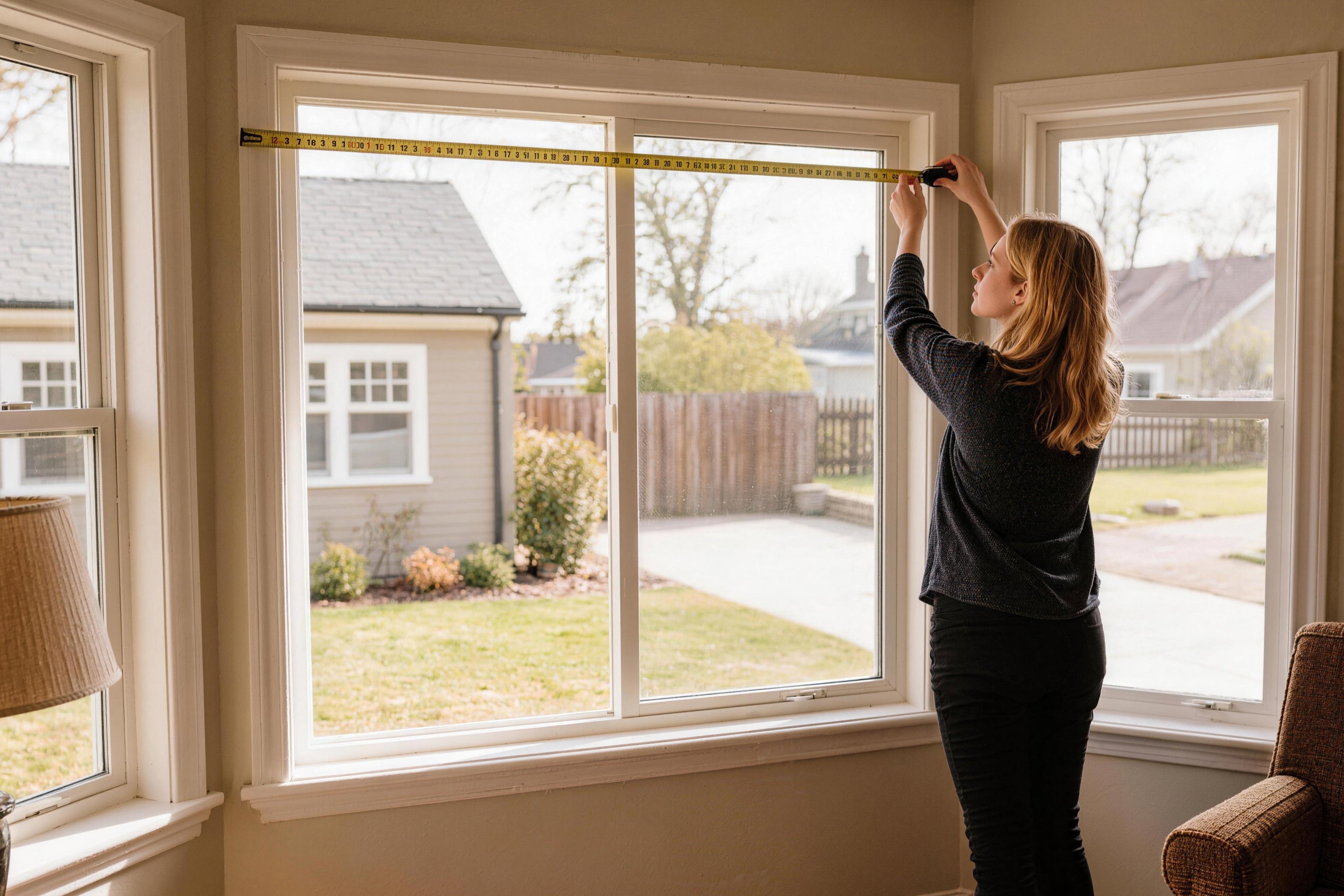
Splitting your wide window into two shades instead of ordering one oversized unit improves durability, reduces shipping risks, lowers costs, and gives you more flexible light control. But many customers then ask: How exactly should I measure when buying two shades for one wide window? This guide walks you through it step by step.
Decide Your Mount Type First
The journey to a perfect fit begins with a simple decision: where will your shades live? Inside Mounts nestle within the frame for a sleek, architectural look, while Outside Mounts hover above the frame to maximize coverage and block out every stray beam of light. Your choice here dictates the "math" that follows.

Inside Mount: Measuring for a Seamless Pair
Inside mount gives a clean, built-in look. When splitting into two shades, the goal is to ensure smooth operation while minimizing the center light gap.
① Measure the Full Inside Width
Start by measuring the inside width of the window frame at the top, middle, and bottom. We recommend using the smallest of these three numbers (or the top measurement for a quick reference) to ensure the shades don't jam during installation.
Example:
If the three measurements are 96", 95 3/4", and 96 1/4", use 95 3/4".
② Manually Deduct Clearance (Important)
Since we build your shades exactly to the dimensions you provide, you’ll need to play the role of the engineer. To allow the shades to move smoothly, subtract 3/8" to 5/8" from your total width.
Example:
Measured width: 95 3/4"
Deduct 1/2" → 95 1/4" adjusted width
③ Divide the Adjusted Width Into Two Sections
Simply take that adjusted width and cut it in half. This ensures both shades look symmetrical and balanced.
Example:
95 1/4" ÷ 2 = 47 5/8" → Order two shades at 47 5/8" each
Please Note: When installing two shades side by side, there will be a small light gap in the center (usually about 1/2"–1"). This is normal and unavoidable due to necessary fabric deductions.

Outside Mount: Measuring for the Grand View
Outside mounts are much more forgiving. Since they sit on the wall, you don't have to worry about tight clearances. This mount type also helps minimize light leakage along edges, providing better light control.
① Measure Total Desired Coverage Width
For outside mount, measure the full area you want the shades to cover — not just the glass. We typically recommend extending 2–4 inches beyond the window frame on each side. This improves privacy and reduces side light leakage.
Example:
Window frame width: 96"
Add 2" on each side → 100" total coverage width
② Divide the Width
Once you have your "ideal coverage width," just divide it by two. No subtractions are needed here!
Example:
100" ÷ 2 = 50" → Order two shades at 50" each

Height Measurement (Same for Both Shades)
Whether you are mounting inside or outside, both shades should share the exact same height. Measure from your top mounting point down to the sill (or where you want the shade to stop). Always provide the longest height measurement for inside mounts to ensure full coverage.
Measure Height for Inside Mount
Simply measure the height in three places: the left, middle, and right. Then go with the longest of the three to ensure your shades provide full, beautiful coverage.

Measure Height for Outside Mount
To find the perfect length, simply measure vertically from the installation point down to your desired coverage endpoint on either the left or right side.

Final Thoughts
When splitting a wide window into two shades, the key steps are simple:
- Measure accurately
- Record the measurement rounded down to the closest 1/8"
- Deduct clearance manually for inside mount
- Divide evenly
- Double-check before ordering
Because we manufacture exactly to the size you submit, precise measurement is essential. Taking a few extra minutes to measure correctly ensures your shades fit properly, operate smoothly, and perform beautifully for years to come.
Frequently Asked Questions
1.How wide is a double window typically?
Double windows (two windows side-by-side in one frame) often range from 48 to 96 inches wide. Because of this width, splitting the shades is highly recommended to prevent the fabric from sagging over time.
2.How to measure blinds for double windows if there is a vertical bar in the middle?
If your window has a center mullion (the vertical divider), measure the width from the left frame to the center of the mullion, and then from the center of the mullion to the right frame. This ensures your split lines up perfectly with the window’s structure.
3.How to measure a double hung window for split shades?
For double-hung windows, follow the standard inside mount steps. Ensure your depth is sufficient (usually 2-3 inches) so the shades don't interfere with the window's hardware or the sliding sashes.
4.What should my double window blinds size be to avoid a large light gap?
When two shades meet, a small light gap (approx. 1/2" to 1") in the center is unavoidable due to the fabric deductions. To minimize this, ensure you only deduct the minimum recommended clearance (3/8") during your calculations.
5.Why does the "width fraction window" matter?
We manufacture to the nearest 1/8". If your measurement falls between fractions, always round down. A shade that is 1/8" too wide won't fit inside the frame, but one that is 1/8" too narrow will still look great.
Share:
How to Choose Window Shades for Wide Windows
Best Window Treatments for Small Apartments