


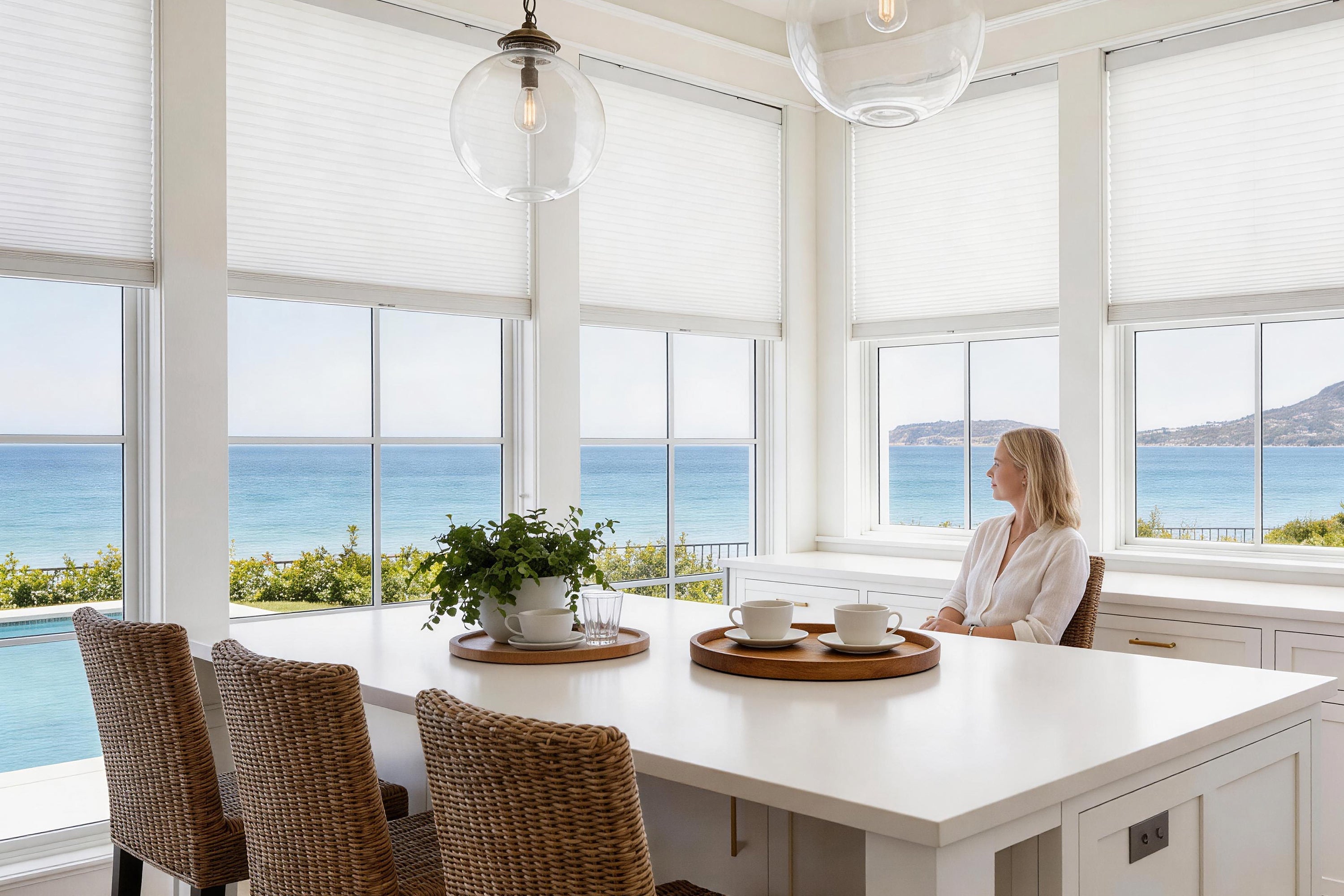
When choosing window coverings, cellular shades are often one of the recommendations, and for good reason. When choosing window coverings, cellular shades are often one of the first recommendations—and for good reason. They combine clean aesthetics with practical performance, offering insulation, privacy, and light control in one streamlined design.
However, not all cellular shades function the same way. As you explore options, you’ll quickly notice variations that go beyond fabric or color. Some prioritize simplicity, while others focus on flexibility or multi-functionality.
This guide compares three of the most common types, standard cellular shades, top-down bottom-up (TDBU) shades, and day-night shades, so you can clearly understand their differences and choose the one that truly fits your space.

What Are Cellular Shades?
The defining feature of cellular shades is their honeycomb structure. Unlike flat window coverings, their fabric forms pockets that trap air, creating a layer of insulation between your room and the window.
This design helps stabilize indoor temperatures, soften outside noise, and diffuse light more evenly. At the same time, it delivers a soft and structured look that feels more refined than typical blinds.
In short, cellular shades aren’t just about covering a window, they actively improve how a room feels.

1.Standard Cellular Shades: Simple, Reliable, and Easy to Live With
If you’re looking for a straightforward solution, standard cellular shades are the baseline. They feature a single honeycomb layer and operate with a simple up-and-down motion. There are no additional mechanisms, making them intuitive and easy to use from day one.
Visually, they’re as clean as it gets. Uniform pleats, soft textures, and neutral color options make them easy to match with almost any interior, especially if you prefer a minimal or uncluttered look.
Functionally, they cover all the essentials. You get privacy, basic light filtering (or blackout depending on fabric), and solid insulation performance. They’re also low-maintenance and durable over time.
Where they make the most sense is in spaces that don’t need frequent adjustment, such as living rooms, home offices, or standard bedrooms. If your priority is affordability, simplicity, and a neat finish, this is the most practical choice.

2.TDBU Shades: More Control Without Over-complication
Top-down bottom-up (TDBU) shades build on the same foundation but introduce one key upgrade: adjustable positioning from both directions. Instead of choosing between fully open or fully closed, you can lower the top or raise the bottom independently. This allows you to control light and privacy with much greater precision.
For example, you can let daylight in from the top while keeping the lower portion covered, ideal for maintaining privacy without sacrificing natural light. This added flexibility makes a noticeable difference in real-life use, especially in homes where windows face streets or neighboring buildings.
Visually, TDBU shades appear slightly more structured due to their dual-rail system, but they still align well with modern interiors.
Why Waterproof TDBU Shades Work So Well in Bathrooms
While TDBU shades are versatile across many rooms, their advantages become especially clear in high-humidity environments like bathrooms. In these spaces, window treatments must handle constant moisture, temperature fluctuations, and frequent cleaning. Standard materials often struggle over time, leading to warping, staining, or mildew.
Waterproof TDBU cellular shades address these challenges on multiple levels. Moisture-resistant fabrics help prevent water absorption, allowing the shade to dry quickly and maintain its structure. This improves long-term durability and reduces maintenance concerns.
At the same time, the TDBU design enhances usability. You can open the top to bring in natural light while keeping the lower section closed for privacy, an essential feature for bathrooms.
Equally important, they retain a soft and refined appearance. You’re not forced to compromise on design in order to gain functionality.
Together, these qualities make waterproof TDBU shades one of the most balanced solutions for humid environments.

3.Day & Night Shades: One Shade, Two Modes
Day-night shades take a different approach by focusing on fabric versatility rather than movement flexibility. They combine two layers, typically a light-filtering fabric and a blackout fabric, within a single system. This allows you to switch between modes depending on the time of day or your needs. During the day, the light-filtering layer creates a soft and diffused glow that brightens the room without harsh glare. At night, the blackout layer provides full privacy and darkness for better rest.
Visually, this dual-layer structure adds depth and dimension. Compared to standard shades, day-night designs feel more layered and visually expressive, making them a stronger design element within the space. They’re particularly well-suited for bedrooms, nurseries, or media rooms where lighting needs change throughout the day.
The trade-off lies in complexity. The structure is thicker, and the system involves more components, which naturally positions it at a higher tier in terms of cost and functionality. Rather than being a minimalist solution, it’s designed for users who want more control in a single product.
Like all cellular shades, day-night options also benefit from the honeycomb structure, meaning they still provide insulation and energy efficiency alongside their light control advantages.

Where the Differences Really Show
While all three types share the same honeycomb structure, the differences become more noticeable once you start thinking about how they’re used day to day.
Light control and privacy are where the gap is most apparent. Standard cellular shades keep things simple, they move in one direction and provide consistent coverage. TDBU shades add another layer of flexibility by letting you adjust from both the top and bottom, which makes it easier to balance natural light and privacy throughout the day. Day-night shades take a different route, offering two distinct fabric layers, so instead of adjusting position, you’re switching between lighting modes depending on the time or setting.
Visually, the distinction is more subtle but still noticeable. Standard cellular shades tend to blend into the background with a clean, minimal look. TDBU shades feel slightly more structured because of their dual-rail design, though they remain visually balanced. Day-night shades, with their layered construction, naturally draw a bit more attention and can act as a more defined design element in the room.
When it comes to overall performance, all three benefit from the same insulating structure. The difference lies in how that core feature is extended. TDBU shades improve everyday usability by offering more control over light and visibility, while day-night shades expand functionality by adapting to different times of day. In spaces with higher humidity or more demanding conditions, material choices, such as moisture-resistant fabrics, can also play a role in how well the shades hold up over time.

How to Choose Based on Real-Life Use
Instead of focusing on product types, it’s often easier to think room by room.
For bathrooms and kitchens, moisture and cleaning frequency are key concerns. Simpler structures are generally easier to maintain, making standard cellular shades a practical option. However, if the window is exposed to water or steam, waterproof TDBU shades are the better choice, offering both durability and flexible privacy.
In bedrooms, light control and comfort matter most. Day and night shades provide the greatest flexibility for managing light throughout the day, while standard cellular shades are a solid option for more basic needs. For street-facing or lower-level bedrooms, TDBU shades offer a useful balance between privacy and daylight.
Living rooms typically prioritize natural light and overall aesthetics. Standard shades work well for a clean, minimal look. For larger windows or stronger sunlight, enhanced light control, either through TDBU or dual-layer designs, can improve comfort.
For bay windows, the choice depends on how the space is used. TDBU shades are ideal if you want adjustable privacy while maintaining light. Day and night shades are better if the space doubles as a resting or sleeping area. Standard cellular shades, on the other hand, keep the look simple and uncluttered.

Conclusion
Each type of cellular shade is designed with a different priority in mind. Standard cellular shades keep things simple and reliable. TDBU shades add flexibility for everyday living. Day and night shades offer dual functionality in a single system. The best choice ultimately depends on how you use your space.
If you’re looking to upgrade your windows with a solution that balances style, comfort, and performance, explore options that match your specific needs, and consider how features like waterproofing or dual-layer design can make a real difference in daily life.
Frequently Asked Questions
1. What makes Waterproof TDBU Cellular Shades better for bathrooms?
Waterproof TDBU cellular shades are designed to handle moisture through specialized fabric treatments and construction. The material is typically treated with water-repellent finishes or protective coatings that help water bead off the surface rather than soak in, while high-density weaving reduces moisture penetration.
This ensures the shade maintains its shape and performance over time. Combined with the top-down bottom-up design, it also allows natural light in while keeping privacy—making it especially practical for bathroom use.
2. Are Day & Night Shades suitable for humid areas?
Day and night shades can work in humid spaces, but their performance largely depends on the fabric. In areas like bathrooms or kitchens, it’s worth choosing moisture-resistant or waterproof materials to prevent long-term wear.
Some brands, including HESTIA, offer waterproof cellular options that combine dual-layer functionality with added durability. If humidity is a frequent concern, choosing this type of material can make a noticeable difference in how well the shade holds up over time.
3. Do TDBU Shades cost more?
In most cases, yes, but the difference is mainly due to their construction. Unlike standard cellular shades, TDBU shades have a dual-direction mechanism that requires additional materials in the track system. This allows for the top-down and bottom-up operation, giving more flexibility in adjusting light and privacy.
Combined with the more complex assembly and optional features like moisture-resistant fabrics, these factors can make TDBU shades slightly higher in price. However, the added cost generally reflects the increased functionality and long-term durability of the product.
4. Are cellular shades really energy efficient?
Yes. Their honeycomb structure traps air and reduces heat transfer, helping maintain indoor temperature more effectively than many flat window coverings like roller shades. This can contribute to improved comfort and energy savings over time.
5. Is installation complicated?
Not really. Most cellular shades are designed to be fairly easy to install, even if you’re not particularly handy.
Many options today don’t require drilling, which makes the process much simpler, you can usually have them up in just 30 seconds without tools or wall damage. It’s a convenient choice, especially if you prefer a clean look or want something easy to adjust later on.
Share:
Waterproof Cellular Shades: A Smarter Solution for Modern Homes
Hestia Cellular Shades Buying Guide: How to Choose and Order the Right Shade Online