


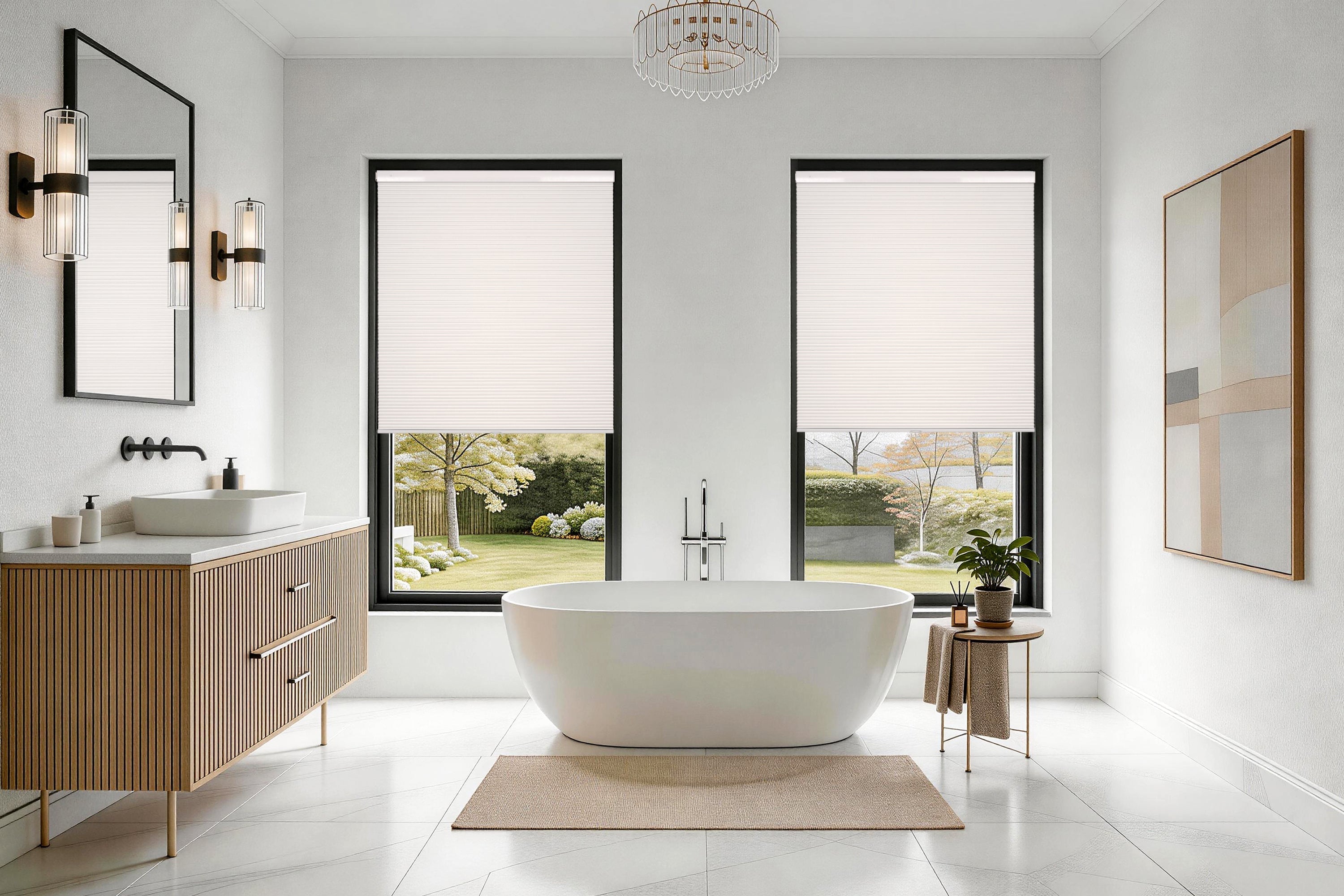
Modern homes are evolving toward cleaner design, smarter functionality, and materials that can keep up with real-life conditions. Window treatments are no longer just decorative, they're expected to perform. In humid environments especially, traditional options often fall short. This is where waterproof cellular shades emerge as a practical, forward-thinking solution.
Waterproof Cellular Shades in 2026
Over the past few years, there has been a clear shift in consumer demand toward moisture-resistant window treatments. Search trends and product innovation both point in the same direction: homeowners want solutions that look refined but also withstand challenging environments.
Bathrooms, kitchens, laundry rooms, and homes in humid or coastal climates are driving this demand. In these spaces, exposure to moisture, steam, and temperature fluctuations is constant. As a result, materials that can resist water, maintain structure, and remain easy to maintain are becoming essential rather than optional.
Waterproof cellular shades represent this shift, combining performance-driven materials with modern aesthetics.

Why Most Cellular Shades Fail in Humid Environments
Traditional cellular shades were originally designed for insulation and light control, not for moisture-heavy conditions. As expectations evolve, their limitations become more apparent.
Most standard options rely on polyester-based fabrics or non-woven structures that, although lightweight and cost-effective, tend to absorb moisture over time. This leads to gradual deformation, sagging, and even mildew. Their surface texture may also becomes coarse or stiff, especially after repeated exposure to damp conditions, diminishing the overall quality and comfort.
The issue goes deeper than surface performance. Beyond the surface, humidity can affect the internal honeycomb structure, causing uneven pleats or loss of shape. Combined with fading from inconsistent dyeing processes, these shades often struggle to maintain both appearance and performance.
Over time, this results in shorter lifespan, inconsistent usability, and repeated replacement. What begins as a simple aesthetic choice turns into an ongoing maintenance issue. Ultimately, the problem lies in the design approach, most cellular shades are adapted to handle moisture, rather than engineered for it. Addressing this gap requires rethinking both material selection and fabrication technology, which is exactly where Hestia's waterproof cellular shades series introduces a meaningful shift.

Hestia Blinds Waterproof Series: A Breakthrough in Moisture-Proof Cellular Shades
Hestia Blinds positions itself as a category innovator, redefining how cellular shade materials are developed for real-life environments. Its waterproof series represents a shift from adapting traditional fabrics to engineering a purpose-built solution, one that integrates moisture resistance, structural stability, and refined aesthetics from the ground up.
Why Material and Process Matter
In conventional cellular shade manufacturing, achieving both softness and waterproof performance has always been a technical balancing act. Softer fabrics usually rely on lighter, finer, or more open constructions, which can compromise resistance to moisture. On the other hand, stronger water resistance is typically associated with denser structures, coatings, or laminated layers, elements that tend to make the fabric feel stiffer or less natural.
This inherent tension between tactile comfort and functional performance is where most materials reach their limit.
Waterproof Cellular Shades: A System-Level Innovation
Hestia Blinds approaches this challenge through a fully integrated material system, where base fabric, structural design, and finishing technologies are engineered together rather than applied separately.
At the foundation of waterproof cellular shades, it is a woven polyester construction, replacing the more basic non-woven structures commonly seen in standard cellular shades. This woven approach delivers a smoother, more refined texture while also enhancing structural integrity, allowing the fabric to maintain its form even under long-term exposure to humidity.

Exclusive Waterproof & Hydrophobic Engineering
Building on this foundation, Hestia Blinds waterproof cellular shades incorporate proprietary post treatment technologies designed to achieve true moisture resistance:
- A waterproof treatment introduced during the finishing stage modifies the fabric surface to reduce water absorption, creating a “lotus effect” where droplets bead and roll off.
- A continuous surface coating layer forms a protective barrier, preventing water from penetrating through the fabric.
- The high-density woven construction further minimizes inter-yarn gaps, reducing pathways for moisture intrusion and supporting performance aligned with AATCC Test Method 35 (Rain Test for Water Resistance) standards.
In addition, hydrophobic technology is integrated at the fiber surface level through both physical and chemical modification methods, such as micro/nano-scale surface structuring and the application of specialized hydrophobic agents during finishing. These treatments alter the surface energy of the fibers, making it more difficult for water to spread or penetrate.
Hydrophobic performance, evaluated under AATCC TM22 spray testing, enhances resistance to splashes and surface wetting, while the broader waterproof construction ensures protection against deeper moisture exposure. Together, they form a layered defense: surface repellency combined with structural waterproofing.
Balancing Softness and Functionality
One of the longstanding challenges in the industry is the trade-off between softness and waterproof performance.
- Fabrics that are softer are typically lighter, finer, or more loosely woven, making them more vulnerable to moisture.
- Stronger waterproofing often depends on coatings, laminations, or dense constructions, which can result in a stiffer, less natural feel.
To enhance performance beyond surface protection, Hestia Blinds addresses this conflict through a "soft base fabric + functional layer" strategy, namely, a composite structure combining polyester with an aluminum film layer.
- A woven polyester base provides a smoother, more refined hand-feel compared to non-woven materials.
- A thin, controlled functional coating delivers water resistance without significantly compromising softness.
- A composite aluminum layer enhances moisture blocking, insulation, and blackout performance.
What distinguishes this system is how these functional layers are applied. Instead of creating a heavy or rigid feel, Hestia Blinds uses refined, thin-layer integration, preserving the fabric's flexibility and avoiding the overly stiff or "papery" texture often associated with laminated materials. The result is a carefully calibrated balance:
- Soft and smooth to the touch
- Structurally stable over time
- Resistant to both liquid water and moisture vapor
Redefining What Cellular Shade Materials Can Do
By combining woven textile construction, integrated waterproof and hydrophobic treatments, and functional composite layering, Hestia Blinds waterproof cellular shades move beyond conventional limitations. It delivers a material that is not only moisture-resistant, but also refined, durable, and adaptable to real-world environments.
This breakthrough in material design sets the stage for a broader range of performance benefits, extending well beyond waterproofing into everyday usability and long-term reliability.
Beyond Moisture Resistance: Performance Benefits for Modern Homes
Moisture resistance is only one part of the equation. What truly elevates a material is how it performs day after day, both in how it feels and how it functions within a living space. Hestia’s approach brings these elements together, ensuring the shades are not only resilient, but also refined and practical to use
From a sensory perspective, the fabric offers a smooth, textile-like finish that feels noticeably more refined than conventional cellular materials. This is paired with a color-stable surface, helping maintain a consistent appearance over time, even with regular exposure to sunlight. In addition, the material is engineered with UV resistance, reducing harmful ultraviolet penetration while helping protect interior furnishings from fading. The surface itself is also designed to be easy to maintain, resisting dust buildup and allowing for simple wipe-clean care.
Structurally, durability is built in. A reinforced construction minimizes the risk of warping or separation, while the stable honeycomb form supports smooth, reliable operation over time. The material holds its shape well, even with frequent use or changing environmental conditions.
Performance also extends into everyday comfort. The honeycomb design helps create an insulating barrier, contributing to better temperature regulation and energy efficiency. At the same time, it assists with noise reduction, making interiors feel quieter and more controlled. Its moisture-resistant construction helps reduce the conditions that allow mold and mildew to develop, making it well-suited for humid environments. For best results, it's recommended to allow the shades to fully dry before closing after exposure to moisture and to maintain proper ventilation in the space.
Light control remains flexible, with options ranging from soft light filtering, room darkening, to full blackout, allowing different levels of brightness and privacy depending on the setting.
And this innovation doesn’t stop at the material level. Hestia Blinds extends it into versatile product configurations, offering multiple waterproof cellular shade styles designed to adapt to different spaces and lifestyle needs.

Designed for Every Need: Hestia Blinds Waterproof Collection
Building on a unified material foundation, Hestia Blinds translates its innovation into a range of product configurations designed for different living scenarios. While each style serves a distinct purpose, they all share the same water-resistant performance, achieved through advanced dyeing or dyeing-plus-composite processes. This ensures consistent durability and appearance across the entire collection, no matter the function or setting.
Cordless Waterproof Cellular Shades
As the most streamlined option in the collection, waterproof cordless cellular shades focus on simplicity and everyday ease of use. The clean, minimal look fits naturally into modern interiors, while the absence of cords enhances safety, especially in homes with children or pets. Operation is intuitive, with a smooth free-stop mechanism that allows the shade to be positioned effortlessly at any height. Combined with waterproof performance, this makes it a reliable choice for both living spaces and moisture-prone areas.
Waterproof Top-Down Bottom-Up Cellular Shades
For spaces that require more nuanced light and privacy control, top-down bottom-up shades offer greater flexibility. By allowing adjustment from both the top and bottom, they make it possible to bring in natural light while maintaining privacy where it matters most. This balance is particularly useful in bathrooms or street-facing rooms, where lighting needs change throughout the day. With the added benefit of water resistance, they perform confidently even in high-humidity environments.
Waterproof Day-Night Cellular Shades
Day-night cellular shades combine two functional layers within a single system, offering a versatile solution for varying light conditions. A light-filtering layer softens daylight, creating a comfortable ambiance, while the blackout layer provides full privacy and darkness when needed. This dual functionality makes it easy to transition from day to night without changing window treatments, ideal for bedrooms, living rooms, or multi-use spaces.
Across all three configurations, the underlying principle remains the same: one advanced material platform, adapted into multiple lifestyle solutions. Rather than choosing between performance and flexibility, Hestia’s waterproof collection delivers both, ensuring each space can be equipped with a solution that fits its specific needs.

Hestia Blinds vs. Traditional Cellular Shades: A Clear Upgrade
When comparing Hestia's waterproof cellular shades with traditional options, the difference is not only visible in appearance, but also embedded in how the material is built and finished, from fabric structure to dyeing methods and functional layering. These underlying factors directly shape how each product looks, feels, and performs over time.
1. Waterproof Performance & Fabric Texture
Hestia's waterproof capability originates from its woven fabric structure combined with integrated waterproof and hydrophobic treatments. The tighter yarn construction reduces gaps within the fabric, while the finishing process creates a surface that resists water penetration. This structural approach not only blocks moisture but also results in a smoother, more refined texture, with a consistent and elevated visual appearance.
In contrast, traditional cellular shades typically rely on non-woven materials, which prioritize cost efficiency and basic shading performance. Without a tightly interlocked structure or advanced surface treatment, they are more likely to absorb humidity. This difference in construction also affects the surface feel, non-woven fabrics tend to appear flatter and feel comparatively coarse.
2.Structural Stability & Durability
From a performance standpoint, the woven structure also contributes to better long-term stability. The fabric and reinforced honeycomb design give Hestia Blinds shades a clear advantage in maintaining their form. The material resists stretching and deformation, allowing the pleated structure to remain intact even after extended use.
By comparison, non-woven structures are more prone to gradual loosening. Over time, this can lead to reduced tension, less defined pleats, and a decline in overall appearance, affecting both durability and user experience.
3.Fade Resistance & Dyeing Process
Color performance is determined by how the fabric is dyed. Hestia Blinds uses a full dyeing process, where color penetrates deeply into the fiber structure. This results in a more uniform tone, eliminating surface-level inconsistencies and ensuring a cohesive visual finish across the entire shade, as well as improving resistance to fading under prolonged sunlight exposure.
Other cellular shades often use surface printing techniques, where color is applied only to the outer layer. While visually effective at first, this method can lead to uneven color distribution and reduced durability over time, especially when exposed to UV light.
4.Maintenance & Everyday Practicality
Hestia’s material system is designed to simplify everyday care while maintaining structural integrity over time. The smooth woven surface combined with moisture resistance reduces the likelihood of dust and residue adhering to the fabric, making routine cleaning quick and effortless. At the same time, the reinforced honeycomb structure helps the shade retain its form, resisting loosening or distortion even after prolonged use or frequent operation.
In contrast, traditional cellular shades, especially those based on non-woven materials without protective finishing, are more prone to dust accumulation and moisture sensitivity, which makes cleaning less convenient and can accelerate wear. Their structure is also more likely to relax over time, leading to less defined pleats and a gradual decline in overall appearance and performance.
5.Light Control & Blackout Performance
Light control in Hestia shades benefits from its composite structure, particularly the integration of aluminum layers in more controlled transitions between filtering and blackout effects depending on blackout configurations. This enhances the ability to block light effectively while maintaining a clean and uniform exterior appearance.
Other cellular shades generally offer basic light filtering, with limited capability for full blackout unless additional layers are introduced, often without the same level of consistency.
6.Insulation & Energy Efficiency
The honeycomb structure itself contributes to insulation, but Hestia Blinds enhances this through higher-performance internal layering, improving heat reflection and reducing thermal transfer. This supports better indoor temperature regulation and energy efficiency.
Traditional options provide a degree of insulation, but without advanced materials, their performance remains more moderate and less consistent in demanding environments.

Where Waterproof Cellular Shades Make the Biggest Difference
Some spaces place higher demands on materials, not just visually, but functionally. Areas exposed to humidity, temperature fluctuations, or frequent use tend to reveal the limitations of standard window treatments over time. This is where waterproof cellular shades show their real value.
In environments like bathrooms, kitchens, and laundry rooms, moisture is part of daily use. Steam, splashes, and changing temperatures can gradually affect conventional fabrics, leading to deformation or reduced performance. A moisture-resistant structure helps maintain both appearance and function, even under these conditions.
Homes in coastal regions face a different but equally persistent challenge. Elevated humidity levels and salt in the air can accelerate material wear, making durability and stability essential rather than optional. Similarly, in rental properties or high-turnover spaces, window treatments need to withstand frequent use while remaining easy to maintain, reducing the need for constant upkeep or replacement.
Beyond these more demanding environments, the same benefits extend into everyday living spaces. Whether it’s maintaining a clean, consistent look in a living room or ensuring reliable performance in a bedroom, a material that resists moisture, holds its shape, and requires minimal care naturally adapts to a wide range of settings.
Rather than being limited to specific use cases, waterproof cellular shades function as a versatile, all-in-one solution, designed to perform reliably wherever conditions are less than ideal.

FAQs
1.Why Waterproof Cellular Shades Are the Future of Window Treatments?
For homeowners, window treatments are no longer just about looks, they need to handle real-life conditions. In spaces like kitchens, bathrooms, or humid climates, traditional shades can warp, fade, or become difficult to maintain over time. Waterproof cellular shades are designed to solve these everyday frustrations, offering a solution that stays consistent in both appearance and performance without requiring constant upkeep.
From a long-term value perspective, they also help reduce the hidden costs of replacement and maintenance. With better resistance to moisture, easier cleaning, and more durable construction, waterproof cellular shades provide a more reliable, low-effort option. It’s not about upgrading for the sake of it, it's about choosing a solution that works better for how people actually live.
2.Do waterproof shades prevent mold and mildew?
Waterproof construction helps limit moisture retention, which plays an important role in reducing the conditions where mold and mildew are likely to develop, especially in humid environments.
For spaces with higher hygiene requirements, additional anti-mold and antibacterial treatments can be applied as an optional finishing process. This involves specialized surface treatments that enhance resistance to microbial growth when needed.
For everyday use, simple care also makes a difference. Allowing the shades to fully dry after exposure to moisture and keeping the area well-ventilated can help maintain a cleaner, more stable environment over time.
3.Can I clean waterproof cellular shades with water?
Yes. For routine cleaning, a feather duster or soft brush can be used to remove dust without affecting the fabric. When needed, you can wipe the surface with a slightly damp cloth to clean off stains or residue, thanks to its moisture-resistant finish.
For more thorough care, mild cleaning with water is generally safe, as the material is designed to resist moisture without deforming, making upkeep simple compared to traditional fabric shades.
Upgrade to Hestia Blinds Waterproof Cellular Shades Today
Waterproof cellular shades represent a smarter way to approach everyday living, combining durability, easy maintenance, and consistent performance in spaces where traditional options tend to fall short. Instead of adapting to limitations, they are designed to handle real conditions with less effort and better long-term results.
Hestia Blinds builds on this idea with its waterproof material system, bringing together refined texture, reliable moisture resistance, and versatile configurations in one cohesive solution.
If you're looking for window treatments that work as well as they look, it may be time to explore a more capable option.
Share:
How to Use Window Blinds to Make Your Apartment Feel Bigger
A Comprehensive Comparison of Cellular Shades: Standard, TDBU, and Day-Night Shades